Showing posts with label SDI. Show all posts

Wednesday, July 16, 2014

BEE SWARMING OCCURRENCE AT SDI

This week, the Sustainable Development Institute (SDI) staff and student interns experienced the natural phenomenon of bee swarming. “It was awesome watching nature in action”, Manih Boyd, student and Administrative Assistant stated after watching the bee swarm fly towards the wooded area behind the campus.


Bees swarming on Birdhouse

Swarming occurs when a new bee colony is formed. The queen bee leaves the colony with a large number of worker bees. Approximately 60 percent of the worker bees join the queen to leave the hive. Swarming usually happens in the spring and is the natural means of reproduction of honey bee colonies.

As part of a summer project, the Place-based Opportunities for Sustainable Outcomes and High Hopes (POSOH) students, a cohort group comprised of high school students and student interns, put up a bluebird house near the SDI garden. About two hours after the birdhouse was up, the students noticed an extremely large amount of bees clinging to the birdhouse. For the next 24 hours scout bees flew looking for a new location for the swarm to live. Upon finding an appropriate spot, they came back to the swarm and perform a dance to indicate direction and distance to the new location. Once a new spot had been agreed upon by the swarm, they flew to the new area.

Friday, December 13, 2013

SUSTAINABILITY LEADERSHIP COHORT HOSTS YOUTH SPEAK EVENT

The USDA P.O.S.O.H. Project recently sponsored the Oskēh-Mamāceqtāwak Kēketōwak: Youth Speak Event hosted by the College of Menominee Nation’s High School Sustainability Leadership Cohort (SLC) to showcase different opportunities for area youth and provide a platform for young people to have their voices heard. On Friday, Dec 6, 2013, about 100 people gathered to celebrate these youth voices, which took various shapes and forms.

Menominee High School Singers


Menominee Prayer by Forrest Madosh Jr.


Dr. Patty Loew, a UW-Madison professor who hails from Bad River Band of Lake Superior Chippewa and focuses outreach efforts on Native youth and digital story-telling, introduced the video/action research panel. She emphasized the importance of youth being at the heart of the storytelling process and the power they had in speaking to many sustainability issues we face. She facilitated a group of Bad River youth in creating the appropriately named film, "Protect Our Future". It spoke to the environmental and cultural threats from the proposed taconite mine in the Penokee Hills near Bad River’s Reservation in Northern Wisconsin.


A packed house in CMN's Cultural Learning Center
watches the student's video presentations


“Your parents and grandparents may remember fighting mining issues with the Crandon Mine…Now we are facing another threat.” Dr. Loew said, noting the intergenerational commonality of the mining issue for tribes in Wisconsin. After viewing the student video, Mr. John Teller, Assistant Dean of Continuing Education and Menominee Language Liaison at the College of Menominee Nation commented, “That [Protect Our Future] video should be shown everywhere.It should get out far and wide. They showed some clips of other taconite mines in Minnesota, and it’s just ugly.”


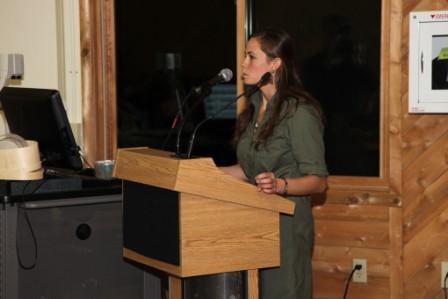
Head of the Sustainability Leadership Cohort, Kate Flick,
introduces the 2013 Cohort for a Q&A Session


SLC Student Jacob Schwitzer fields a question from the audience.

The SLC high school students from Menominee Indian and Shawano High schools also introduced and showed their action research projects. Dylan Enno, Jaime Oshkeshquoam, Chelsey Haberl, and Susan Webster filmed, produced, and edited a film about obstacles to Menominee athletes reaching their full athletic potential called "Work Hard Play Hard". Brandon Reiter, Mylia Olson, and Jade Oneil constructed some garden beds over the summer and showed pictures of their project (as well as serving tea from the dried plant leaves). Jacob Schwitzer, Nicholas Schwitzer, and Ania Smith created a film "Nama’o: The Ancient Story Teller" on the sturgeons’ relationship to the Menominee people in the past, present, and future.


SLC Student Dylan Enno humorously answers a question


The SLC fielded a variety of questions from the audience on their projects: what’s next, what were your greatest challenges and accomplishments, will you create more films, where are you sharing the films, etc? Though the group had bumps along the way, it was clear they had formed a unique bond and appreciated the rewards of project-based learning. Dylan Enno summed it up when he said, “We had our share of challenges…but in the end, we are like family.”


Members of the 2013 Sustainability Leadership Cohort and their Mentors
(From Left: SLC Students Dylan Enno, Jacob Schwitzer, Nicholas Schwitzer,
Jaime Oshkeshequoam, Mylia Olson, Chelsey Haberl, Brandon Reiter, Susan Webster,
SLC Leader Kate Flick, SLC Mentors Cherie Thunder, Connie Rasmussen, and Lloyd "Boobie" Frieson)

Friday, August 9, 2013

Elder and Community Input Day at Mawawceseniyah

On July 31st, the High School Sustainability Cohort (SLC) hosted an Elder and Community input day at Mawawceseniyah.  About thirty-five people attended to hear what the SLC has been working on and give the students feedback and input.  Each of the three groups presented their projects—speaking to the action-research project process they had been implemented over the past several weeks.Ron Corn Jr., Menominee language and culture student and teacher, led the high school student and community members in constructing the frame of a wigwam on the shore of LaMotte Lake. Ben Grignon, CMN and Menominee Indian High School art instructor, shared techniques he learned in New Mexico to add decorations a wood fire clay oven.  For the entire story, see the Sustainable Development Institute website. 


Many thanks to our generous hosts at Mawawceseniyah and the people who contributed their perspectives and feedback.

Tuesday, July 16, 2013

Sustainability Leadership Cohort Action-Research Project and Film Production

Sustainability Leadership Cohort Action-Research Project and Film Production
By: SDI Education Intern, Ella Keenan
Students learn about film production
After much anticipation, the Sustainability Leadership Cohort’s action-research projects are finally underway. The Action-Research Project will give students the opportunity to research a topic that interests them and help them get more involved in their community. The action-research project is designed to teach students valuable researching skills with the end goal of their project being implemented and communicated in the community. Through the process they become the directors of their own learning as they are in charge of choosing what they learn.

The action component involves engaging the community in some form—whether implementing a project, interviewing community members, or addressing an important community need.  Students must then translate these research and implementation experiences into a communication form of their choosing.  As we enter the information age, communication skills will be crucial for students’ success.  A potential medium for communication could be, though is not limited to, film--using documentary, news, or fiction formats to tell a story about a topic. Students who elect to put together a film will have a great foundation after attending a film workshop run by filmmaker Reynaldo Morales from the University of Wisconsin-Madison. In the workshop, Reynaldo introduced the basic techniques of filming and the many parts of a film production.
Sustainability Leadership Cohort students learn film software
Cohort students will be working collaboratively in groups of three or four depending on the amount of people interested in a topic. Group members not only have to agree on a research topic, but they also have to come to a consensus on the type of project they want to implement. In this way, cohort students will learn valuable group dynamic skills that will benefit them later in life.

So far, the students have determined their groups and have narrowed down their research topic. They are now working on their Project Proposals which will clearly outline and define the parameters of their project. The proposals will have to be approved by the Cohort Mentor Team before the group is able to proceed with their project.

After about a week of planning, the groups have only three weeks remaining to research and implement their project. So far, the research topics include the importance of oral traditional through the eyes of a sturgeon, planning and planting a traditional garden with medicines and foods, and researching what is preventing natives from reaching their full potential in areas like sports.

Reynaldo Morales, Filmmaker
Throughout the process, the groups will be required to check in with the Cohort Mentor Team at various stages. Since the goal of the Action-Research Project is for the students to define their own projects based on their own interests, the Cohort Mentor Team’s role is merely to guide the group into a project with a scope can be completed within the time limit.

By completing this process, the students will realize that through film and action they can create awareness in their communities and make a difference. 

Wednesday, July 10, 2013

"I couldn't think of a better day at work," an Internship Experience

Sheldon Waupochick, SDI Intern

My internship experience started with meeting new people, which so far is the best part.  A group of new people going through the same new experience as me; it was a very comfortable feeling.  The first thing we learned about was SEK (scientific ecological knowledge) and TEK (traditional ecological knowledge).   Looking at a forest and applying both of these methods to understand the true components, both traditionally and scientifically.  It was very interesting to learn more in-depth about the same forest I lived in a majority of my life.  With the presence of Dr. Kimmerer, instructor from SUNY ESF, I had much help in understanding factors that affect the rate of tree growth, species, soil depth, and temperature.  I found out that there is an answer to all these factors, and it is “It depends.” I now have a better knowledge of tree identification, which is kind of annoying now that I am always trying to identify trees outside of work. 

With the other interns from SUNY ESF, we took several trips to various vantage points throughout the Menominee reservation.   I thought it was “cool” to be able to help show these people from New York the “Dells” and other places where I have been enjoying recreational activities my whole life.  Places like the “Dells” probably don't exist many other places on earth and we had the opportunity to explore the area and learn in depth of the tree species with Dr. Kimmerer.  At that moment, I couldn't think of a better day at work than that.

On the 6th of June, the other interns and I were given the opportunity to attend the 37th Annual National Indian Timber Symposium.  Located in the conference center of my hometown I learned from many interesting people.  During the symposium I learned about climate-change, forest ecology, invasive species, and species range shifts.  These instructors came from all over the country, and I was most pleased to spend time with instructor Tony Waupochick, who is my father.  During a tour of the Menominee reservation and Stockbridge reservation I met another Native American from California.  We had several conversations, and in one of them, he said he met the president and had dinner with him. I thought that was very interesting. 

As an LFTL intern, we were given a task to team with SUNY ESF interns and repair an Oak Wilt Gap.  This Oak Wilt Gap was an area on the Menominee reservation that has been exposed to the Oak Wilt Disease.  Mentored by Jeff Grignon (Menominee Forester), we as a group, got to decide the future of this piece of land by how we would repair it.  First we had to think about how the forest sustains us, and how we sustain the forest.  After learning a variety of aspects of forest management we applied these methods to our Oak Wilt Gap prescription.  Menominee Tribal Enterprises has the capability to prescribe burn or manipulate land mechanically with machines or men with chainsaws.   In a group presentation we described how we recorded the tree species, temperature, and other data of the area.  In two weeks we completed our prescription and possibly made our mark on the future of the Menominee forest. 


After completing only half the internship I feel I've learned a lot.  I can’t wait to get the opportunity to travel to the Huntington Wildlife Forest, New York and live vise versa of SUNY ESF interns.  I believe that the Sustainable Development Institute is making great strides in innovating learning experiences to us interns.  The second best factor of this internship is that I get to keep my knowledge forever and apply it throughout the rest of my educational journey. 

Blog post written by Sheldon Waupochick, Summer 2013 CMN SDI Intern for the Learning From the Land Experience

Friday, May 10, 2013

CMN Plants Trees for Arbor Day


This morning College of Menominee Nation planted two trees near the Sustainable Development Institute. The trees were gifted from Walmart in honor of Arbor Day 2013.

Shown from left to right: 
Nancy Holtz - Community Involvement Associate. Walmart
Dr. Verna Fowler - President, CMN
Dennis Jolin - Store Manager, Shawano Walmart
Schyler Martin - Interim Sustainability Coordinator, CMN SDI
Gary Besaw - Dean of Student Services, CMN
Lloyd Frieson - Student, CMN
Dean Fellman - Director, CMN Center for First Americans Forestlands
Julie Edler - Social Media Coordinator, CMN SDI
Chris Caldwell - Director, CMN SDI
Patrick Waukau - Multimedia and Outreach Specialist, CMN SDI
Joel Kroenke - Facilities Director, CMN
Melinda Cook - Executive Administrator, CMN


Nancy Holtz, Community Involvement Associate for Walmart, gave a few words about Arbor Day and CMN staff and students planted the trees.

"Some people may ask 'Why are we getting a tree, we've got a million trees here,' but it's one more tree," said Gary Besaw, "We're all related. We always need to remember to be humble and good and gracious when a gift is offered." 
Thank you for the trees!

Thursday, May 2, 2013

"Heating the Midwest" - Is biomass thermal fuel an option?


The forest products industry has been impacted by the downturn in the housing sector and a diminishing paper industry.  However, harvest levels have been well below what most consider sustainable removals even during peak demand.  Because of the low populations in the rural areas, it is not cost effective to pipe natural gas into these areas.  The result is that most of the heating is done with heating oil (primarily East coast) or Liquid Propane (LP-primarily Midwest).  Biomass, especially wood pellets, are a very cost-effective alternative to either heating oil or LP, with a general ROI of 5 to 7 years.  In other words, the money saved over a 5 to 7 year period to heat homes or businesses with wood verses oil or LP would pay for the capital cost of the boiler or wood stove.

From an environmental perspective, these newer wood burning appliances are extremely energy efficient, with most having emission factors similar to heating oil. By most accounts wood is considered to be a carbon neutral fuel source (combustion does not add to the carbon footprint). Innovations and advancements in technology have also made many of the systems fully automated, with a minimal amount of routine annual maintenance.  Reliability (uninterrupted service) has also improved significantly with the last few years.   Further, many of the heating systems can be retrofitted to an existing system to create a “dual system” which can be easily switched between the two fuel sources (i.e., wood to LP and back to wood).

Co-generation or combined heat and power (CHP) are also potential opportunities to expand the use of biomass.  This involves using biomass (wood) to generate electricity and/or heat and electricity.  However, to be cost effective the scale of these systems is typically many times larger.  For example, a 25 megawatt power plant will use in the vicinity of 250,000 tons of wood fuel per year.  A residential home heating primarily with wood will typically use less than 10 tons per year.   While there is potential here to increase the use of an under-utilized wood resource, it is very important that larger facilities be strategically located and appropriately scaled for them to maintain economic viability.
 
Pictures show a wood pellet manufacturer (Great Lakes Renewable Energy), a small-scale commercial heating system (Midwest Forest Products), and a large-scale electric utility (Excel Energy) in Wisconsin. These locations emphasize the versatility of wood for heating and electrical generation and the advancements (many recent) in the combustion technology to render wood as a clean and cost effective alternative. 

It is very likely that using biomass for thermal and CHP applications will remain a hot topic of interest and action in the coming years.  Some have gone as far as saying the wood energy sector will save the forest products industry in the future.  While that is a bold statement there is little doubt this is a huge area of opportunity. Some of the statistics that support this include:
  •          78% of every dollar spent on LP and heating oil leaves the regional economy
  •          Wind development produces .6 jobs per megawatt hour of electricity.  Biomass use supports 14 jobs per megawatt hour
  •          The biomass fuel supply chain the Midwest alone has the potential to produce over 13,000 new jobs (direct, indirect, and induced)

Simply put, expanded use of biomass creates jobs within the local economy while utilizing a renewable resource which reduces our use of and dependence on fossil fuels.  However, it must also be noted that for this use to be considered sustainable long-term, the wood supply must originate from well managed forests. Current estimates indicate the supply and availability of low-grade round wood and residual materials from processing significantly exceed demand (end use).  The key to driving further innovation and use of this resource will be to strategically increase the use of woody biomass for both thermal and CHP applications by displacing LP and heating oil use.  The Sustainable Development Institute and Center for First Americans Forestlands will be monitoring these dialogues and developments in this emerging field of opportunities. 


Much of the information and resources gained from this article came from Dean Fellman's recent experience at the "Heating the Midwest" conference in Carlton, MN where he served as a representative of CMN/SDI through the Center for First Americans Forestlands. Heating the Midwest (HTM) is a group of volunteers with a serious interest in growing awareness and usage of biomass thermal fuel for heat in the Midwestern U.S. These volunteers have formed a steering committee of 13 people from diverse backgrounds and interests that have formed an efficient group of biomass advocates that work towards promoting biomass to a larger constituency, primarily through the conferences offered. This was the second annual Midwest conference which has been patterned in a very similar manner to the “Heating the East” conferences which are conducted in the New England states along the East coast of the U.S. and recently offered their 5th annual event. These 2 areas of the country share a number of characteristics that make them unique in terms of biomass utilization, especially for thermal (heating) applications.  They are in cold weather climates, have extensive forest resources, and have large sparsely populated areas within the forested landscape.

Friday, February 8, 2013

SDI Participates in Federal Outreach and Science Planning Meetings

SDI Director Chris Caldwell (right)
Photo property of http://necsc.umass.edu


Sustainable Development Institute's Involvement in NECSC: 

Chris Caldwell, College of Menominee Nation Sustainable Development Institute Director, and Dean Fellman, Director of the Center for First Americans Forestlands, recently attended two regional stakeholder meetings for the Northeast Climate Science Center (NECSC). NECSC is part of a federal network which provides scientific information, tools, and techniques to assist managers and other institutions interested in land, water, wildlife, and cultural resources to adapt to climate change.

Both regional stakeholder meetings took place in January 2013, the first at the University of Massachusetts in Amherst, MA, and the second at the University of Minnesota in Minneapolis, MN. Chris Caldwell gave presentations at both meetings on Science -  “ Impacts of Climate Variability and Change on Cultural Resources”. Chris also facilitated small group discussions on this theme. Dean Fellman used the small group sessions to emphasize the importance of forests in the geographic region covered by NECSC, their vulnerability to climate change, and thus the need to include them as a priority resource for continued research.

Dr. Bill Van Lopik and Dr. Mike Dockry also participated as members on the CMN team to the consortium, and attended the Minneapolis meeting to participated and share their input.

Read an article about the NECSC stakeholder meeting here from the NECSC website.


Below is more information about the NECSC, partnerships, and grant and funding information:

“The Northeast Climate Science Center (NECSC) is part of a federal network of eight Climate Science Centers created to provide scientific information, tools, and techniques that managers and other parties interested in land, water, wildlife and cultural resources can use to anticipate, monitor, and adapt to climate change."

Recognizing the critical threats and unique climate challenges and the expansive and diverse
nature of the NE region, no one institution can provide the region-wide expertise on all critical
levels. Thus, the University of Massachusetts Amherst (UMass), College of Menominee Nation
(CMN), Columbia University (CU), Marine Biological Laboratory (MBL), University of
Minnesota (UMN), University of Missouri Columbia (UMO), and University of Wisconsin-
Madison (UWI) have formed the Northeast Climate Consortium (NECC) to host the DOI
NECSC, providing the USGS with deep and diverse resources for successfully meeting the
regional needs for climate impact science assessment, education and stakeholder outreach
throughout the NE region. In addition to the host institutions, the NECSC will include several
resource management partners, including Landscape Conservation Cooperatives (LCCs) that
exist, in part or whole, within the NE CSC bounds.” (More information about the NECSC can be
located on their website at http://necsc.umass.edu)

All of the domestic climate science centers are currently funded through grants from the Department of Interior (DOI), through initial 5 year awards which can be renewed. The NECSC is the most recently formed unit of the network and is in the process of developing a strategic science agenda to reflect evolving partner needs. The agenda essentially consists of seven “Science Themes” which will be validated through a process of review and input which includes regional stakeholders. Once validated, NECSC will produce an annual science plan that outlines the research goals for each fiscal year. These goals will then reflect priority research areas which will be used to select specific proposals offered via the consortium members for additional funding.


Tuesday, February 5, 2013

Menominee Culture and History Film Project for Education

On the afternoon of January 16th, Reynaldo Morales geared up and headed out to the Menominee forest.  Armed with a crew of educators, Menominee forestry buffs, sustainable development gurus, and a force of "POSOH" curriculum developers, he grabbed his camera and started the filming process for an eighth-grade lesson plan.


Instead of the traditional textbook way of learning, students are challenged to think about where they live and how issues may effect their everyday life. "They do their own thinking," says Hedi Lauffer, Director of the Wisconsin Fast Plants Program. Through different case studies and formats, students are exposed to new ways of integrated learning. "They get their head wrapped around the subject in a video, story, graph, audio, or other learning tools," noted Lauffer. The video is part a POSOH curriculum development  project. By involving students in different stories of land management practices through video and hands-on projects, students dive deeper into the material and learn applicable lessons.


In the sixteenth, the film crew was filming Menominee raised garden beds. Area students are able to see first-hand what this kind of management may be like. "The eighth grade unit puts an emphasis on demonstrating to students how value systems impact land management and what impacts they have on the land," says Kate Flick, SDI Education coordinator.
In this video, Jeff Grignon, Forest Development Forester for Menominee Tribal Enterprises, explains how Menominee people managed the land and how the raised gardens work.  Students get to compare and contrast this way of
land management verses a modern-day production farm and weigh the costs and benefits. At the end of the unit, students should understand how the ecosystem is impacted in land-based values.


"POSOH" works to develop place-based learning curriculum by developing multicultural learning materials and opportunities. The goal is to build student's understanding of sustainability and prepare them how to view and solve sustainability issues in the present and near future.


Friday, January 11, 2013

New Year’s Resolution


by Julie Edler, SDI Social Media Coordinator

Happy 2013! I must say, I’m ready for a new year and can’t wait to see what 2013 has in store. Though I don’t always have a resolution, I have one this year and plan to fulfill an old grade-school dream of mine – to be able to do the splits. It will take practice to get into a stretching routine, but I think with some hard work and dedication it will be done. However, in addition to this promise to myself, I've also made a promise to the earth –to use less. I don’t always appreciate the amount of resources I use in my everyday routine. By using less, I can practice living more sustainably and not just “talk the talk.” If you would like to join me in my adventure, make 2013 your “Year to Use Less” as well.

I started to think about how much unnecessary “stuff,” is purchased each year – a shirt, an extra dish, a new phone, DVDs, junk food wrapped in plastic and other items we've become accustomed to as “necessary” over the years. Now, I’m not a big spender by any means, but I still buy things here and there for a sporting event, family function, or whatever the case may be. “The most effective way to reduce waste is to not create it in the first place,” says the EPA, “making a new product requires a lot of materials and energy: raw materials must be extracted from the earth, and the product must be fabricated and then transported to wherever it will be sold.” What the EPA is saying is that the best way to save our natural resources and money and protect the environment is to either re-use or don’t purchase at all.

According to the National Geographic Greendex (a tracking survey of consumer choice and the environment), with less than 5 percent of the world’s population, the U.S. uses a third of the world's paper, a quarter of the oil, coal and aluminum, and 19 percent of the copper.

So, not only will I work toward being able to do the splits, but I will also buy less. Remember with every purchase that it took resources to make, build, and ship that product and it will most likely end up in a landfill (probably far too quickly). Here’s to using less in 2013 and being able to do the splits! Good luck with your resolutions and check out the links below for more information on the subject:

EPA recycling and reducing info: http://www.epa.gov/recycle/reduce.html
Article about wasted food: http://www.nrdc.org/food/wasted-food.asp
Article from the Scientific American on US Consumption and the Environment: http://www.scientificamerican.com/article.cfm?id=american-consumption-habits